
If you spend most of your day on your feet, or you have recently picked up a more active routine, there is a good chance you have felt that familiar ache in your heels or arches by the time evening comes around. It is easy to chalk it up to tiredness. But when the discomfort starts showing up more regularly, a lot of people turn to yoga as a first line of relief.
It makes sense. Yoga is low-impact, accessible, and already built around stretching and body awareness. If tight muscles and overworked joints are contributing to your foot pain, a regular practice could genuinely help. But the answer to whether yoga can fix foot pain is not a simple yes or no. It depends on what is causing the pain and how far along it has progressed. If you are looking for a starting point, there are some solid options covered in this guide to yoga poses for sore feet that are worth trying before anything else.
What Kind of Foot Pain Responds to Yoga
Not all foot pain comes from the same place. Yoga tends to work best for pain that is rooted in muscle tightness, poor flexibility, or the kind of cumulative tension that builds up from long hours of standing, walking, or repetitive movement.
The plantar fascia, a thick band of tissue that runs along the sole of your foot from the heel to the toes, is one of the most common sources of foot discomfort. When it gets tight or inflamed, you feel it as a dull ache or sharp pain, often worst in the morning or after sitting for a long time. Tight calves almost always play a role, because the calf muscles connect through the Achilles tendon directly to the heel bone, pulling on the same structures that support the arch.
Yoga addresses both of those things. Regular stretching keeps the calf and plantar fascia more pliable, which reduces the load on the heel and arch during everyday movement.
The Poses That Make the Most Difference
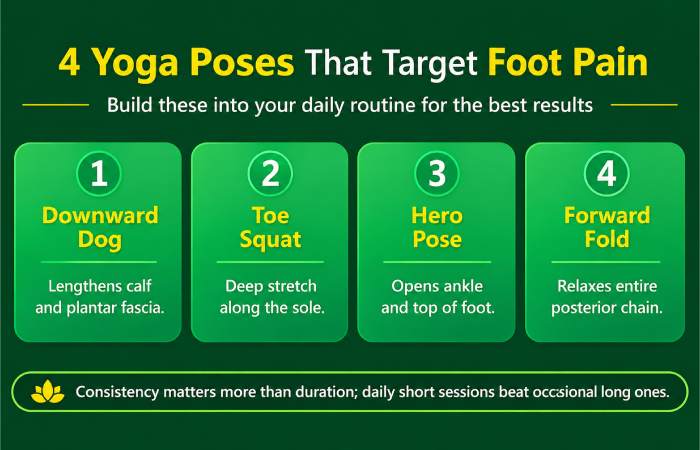
If you want to target foot pain specifically, these four poses are worth building into your routine. They work on the tissues most commonly involved in foot and heel discomfort.
Downward Facing Dog lengthens the entire back of the leg, from the heel through the calf and hamstring. Hold it for five to eight breaths and focus on pressing the heels gently toward the floor. Even if they do not reach, the stretch through the calf is doing useful work.
Toe Squat is uncomfortable for most people the first few times, which is a good sign that it is targeting something that needs attention. Come onto your knees, tuck all ten toes under, and sit back onto your heels. The sole of the foot gets a deep stretch that most people never otherwise access.
Hero Pose (Virasana) opens the ankle and the top of the foot, which is the counterbalance to poses that focus on the sole. Sit between your heels with the tops of your feet flat on the floor. Use a folded blanket under your seat if the stretch is too intense at first.
Standing Forward Fold lengthens the posterior chain from the base of the foot upward. For foot pain specifically, try it with a slight bend in the knees and focus on the sensation through the arch rather than trying to touch the floor.
Doing these four poses consistently, ideally daily rather than a few times a week, produces noticeably better results than sporadic practice. The goal is to maintain flexibility in the tissues, which means regular short sessions beat occasional long ones. For people who are building a more active lifestyle overall, pairing this kind of targeted stretching with habits that support building your stamina for an active lifestyle makes the whole approach more sustainable.
When Yoga Is Not Enough
Yoga is a good tool for foot pain, but it has limits. If the discomfort you are dealing with has been around for more than two to three weeks without improving, if it is worse in those first few steps out of bed in the morning, or if it is starting to change how you walk, those are signs that something more than tightness is going on.
Persistent plantar fascia inflammation does not always respond to stretching alone. At a certain point, the tissue needs clinical support: a biomechanical assessment to understand what is driving the problem, orthotics to redistribute load through the foot, or targeted treatments that promote healing in tissue that has been under repeated stress.
Getting a proper evaluation for plantar fasciitis treatment at Beaver Valley Foot Clinic at that stage gives you a clear picture of what you are actually dealing with and what it will take to resolve it, rather than continuing to manage symptoms that are not fully improving.
The earlier that assessment happens, the simpler the treatment tends to be. Most cases of plantar fasciitis that are caught within the first month respond well to conservative care. The ones that drag on for six months or more are much harder to shift.

Building a Foot-Friendly Routine
The most effective approach to foot pain is not yoga alone or medical treatment alone. It is both, combined with a few everyday habits that reduce the load on your feet in the first place.
Footwear matters more than most people give it credit for. Shoes that have lost their cushioning or arch support keep loading the plantar fascia in ways that undo the benefit of your stretching practice. Replacing them before they look worn rather than waiting until they fall apart is a simple change with a real impact.
Taking your shoes off and doing two to three minutes of calf stretching before you get into bed is one of the most underrated habits for foot health. The plantar fascia tightens overnight, which is why the first steps in the morning are often the most painful. Stretching before sleep reduces how much it contracts.
Rest days are not optional if your feet are already hurting. The tissue needs recovery time to repair itself, and continuing to load it daily slows that process down.
The Bottom Line
Yoga can genuinely help with foot pain, particularly in the early stages when tightness and reduced flexibility are the main factors. The poses that target the calf, sole, and ankle are worth making a consistent part of your routine, and many people find that a daily ten-minute practice makes a noticeable difference within two to three weeks.
What yoga cannot do is resolve structural problems or persistent inflammation on its own. If your foot pain has been around for a while and is not responding to stretching and rest, that is worth taking seriously rather than waiting out. Getting it assessed early almost always means a faster and simpler recovery.
